Intercom vs Zendesk: Pricing, AI Costs, and Which Fits a Small Team

Intercom and Zendesk are the two names that come up first when a growing support team goes shopping, and most comparisons between them stop at feature checklists. The more useful question in 2026 is how each one bills, because both have moved their AI onto usage-based pricing and the two models behave very differently once your volume grows.
Here is how the two bills compare in 2026, and how to tell which side you fall on.
Seats: what you pay before any AI
Both vendors price per seat per month, and both quote their cheapest rate on annual billing.
| Entry plan | Mid plan | Top published plan | |
|---|---|---|---|
| Intercom | Essential $29 | Advanced $85 | Expert $132 |
| Zendesk | Support Team $19 | Suite Team $55 | Suite Professional $115 |
The $19 and $29 entry points are not the same product. Zendesk's Support Team plan is ticketing-focused; its messaging, help center and voice capabilities live in the Suite, which starts at $55. Intercom's Essential includes its chat-first inbox from the start. Compare Suite Team against Essential if you want messaging on both sides, and the gap narrows to $55 against $29.
Neither has a free plan. Both offer a 14-day trial. For Zendesk's complete plan structure, including how its AI resolutions and add-ons are billed, see how much Zendesk costs in 2026.
The AI split: both bill by outcome, and they count differently
This is the part worth slowing down on, because it is where the two bills diverge and it is not visible on a feature chart.
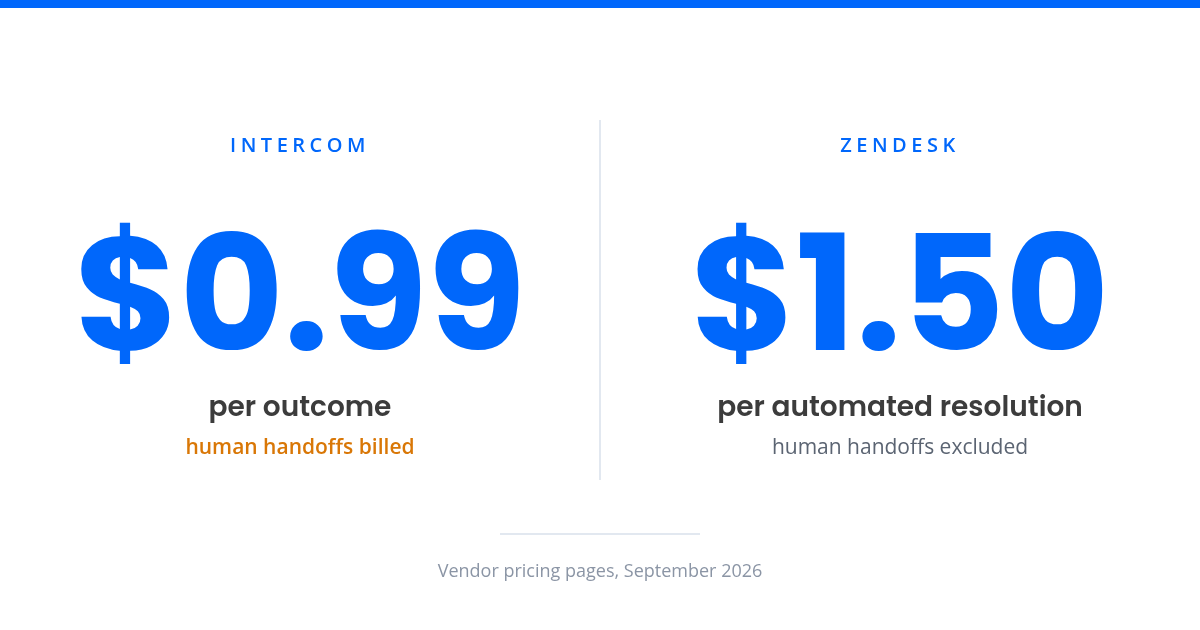
Intercom prices Fin, its customer-facing AI agent, at $0.99 per outcome, published on its pricing page, and bills at most once per conversation. Intercom counts an outcome three ways: the customer confirms the issue is resolved, the customer stops asking for help after Fin responds, or Fin completes a configured workflow. That third case includes handoffs to a human.
Zendesk has moved to the same shape. Its pricing page says AI agents are "included in every Suite and Support plan, with pricing based on the successful outcomes they deliver," measured in automated resolutions. The plan comparison table on that page lists $1.50 per automated resolution when you commit to a volume in advance and $2.00 pay-as-you-go, on every plan, with 5 to 15 resolutions included per agent each month depending on the plan.
The two vendors are also not counting the same unit. Zendesk's pricing page defines an automated resolution as a request "successfully resolved by the AI agent, without any escalation to a human agent." Intercom's definition includes a completed workflow even when the conversation is handed over. A conversation that opens with AI and finishes with a person can therefore be billable on Intercom, while Zendesk's published definition excludes it. Check that against your own escalation rate before comparing the two on rate alone.
That difference matters more than it first appears. Zendesk charges more per unit, $1.50 to $2.00 against Intercom's $0.99, but counts fewer units, because a conversation that reaches a person does not bill. Which one costs less depends on your escalation rate. A team whose AI resolves most conversations cleanly pays less on Intercom. A team whose AI hands off a large share can pay less on Zendesk, even at the higher rate.
One caution on the Zendesk side. Its help center describes a newer billing model, introduced May 18, 2026, that tracks resolution tiers against a dollar allowance and uses placeholder prices in its examples. Ask sales which model your account will be on, and get the rate in writing.
Help Scout draws the line in the same place Zendesk does. Its published definition also excludes conversations that reach a person, which makes Intercom the outlier of the three on how it counts. We worked through what that does to a bill in Intercom vs Help Scout.
Agent-facing AI: the one clean like-for-like
Both platforms also sell an assistant for your staff rather than your customers, and both call it Copilot. Here the comparison is direct:
| Copilot, per agent / mo (annual) | |
|---|---|
| Intercom | $29 |
| Zendesk | $50 |
Same category of product, and Zendesk's costs about 72% more per agent. For a five-person team that is $145/mo against $250/mo for the agent assistant alone, before seats.
Intercom also gives every seat 10 Copilot conversations a month at no charge on all plans, which is enough to evaluate it but not enough to run a team on.
The add-ons that move the floor
Zendesk prices several capabilities as separate per-agent line items: Workforce Engagement at $50 and Contact Center at $83, both per agent per month on annual billing. Intercom's published add-ons work the same way, and we broke those down in detail in our full breakdown of Intercom's 2026 pricing.
The practical effect on both platforms is that the quoted entry price and the invoice rarely match.
What a five-person team pays
Seats only, annual billing, before any AI:
- Intercom Essential: 5 × $29 = $145/mo
- Zendesk Suite Team: 5 × $55 = $275/mo
- Zendesk Support Team: 5 × $19 = $95/mo, ticketing-focused
Now add AI at 1,000 conversations a month with a 30% deflection rate, roughly 300 billable conversations. On Intercom that is about $297 at $0.99. On Zendesk Suite Team, five agents include 25 resolutions a month, and the other 275 cost about $413 committed or $550 pay-as-you-go. That assumes both vendors count the same 300 conversations, and Zendesk's definition excludes any that reached a person, so its billable count will usually be lower.
How to choose
Choose Zendesk if you are running high ticket volume, need mature routing, SLAs and reporting, and you have the procurement time to negotiate AI pricing properly. Its depth at scale is genuinely hard to match.
Choose Intercom if conversational, chat-first support is central to your product experience and your AI resolves most conversations without a handoff. That is where its lower per-outcome rate pays off.
Choose neither if you are a small team and most of the bill is going to capabilities you do not use yet. Both are built for organizations with a dedicated support function, and both charge accordingly.
Where an all-in-one fits
If your team is small enough that a support tool is one of several things you are buying, the arithmetic changes. Pavior puts live chat, a CRM, session replay, a help center, campaigns and feedback in one tool, priced at $0, $25 and $99 per month rather than per seat.
The free tier gives a two-person team every feature, and paid plans add seats as you grow. It is worth being straight about the ceiling: economy covers four seats at $25, so a fifth person moves you to the $99 plan. That is a cliff, and it is in our pricing the same way per-seat cliffs are in theirs.
If you are weighing the wider field rather than just these two, our roundup of the best customer support software for small SaaS teams covers the rest, and we go deeper on the cheaper alternatives to Intercom and on alternatives to Zendesk.
Sources
- Intercom: Pricing
- Zendesk: Pricing
- Zendesk: AI for customer service